Monday, June 13, 2016

stlingrad

he Battle of Stalingrad (July 17, 1942-Feb. 2, 1943), was the successful Soviet defense of the city of Stalingrad (now Volgograd) in the U.S.S.R. during World War II. Russians consider it to be the greatest battle of their Great Patriotic War, and most historians consider it to be the greatest battle of the entire conflict. It stopped the German advance into the Soviet Union and marked the turning of the tide of war in favor of the Allies. The Battle of Stalingrad was one of the bloodiest battles in history, with combined military and civilian casualties of nearly 2 million.
This monumental battle is justly considered a turning point in the war on the Eastern Front and one of the most crucial engagements of World War II. The invading Germans saw the conquest of Stalingrad as essential to their campaign in southern Russia, since from this strategic point on the Volga River they could launch further assaults in the Caucasus. The Russians were determined to defend the city as a vital industrial and transportation center. Both Joseph Stalinand Adolf Hitler understood the symbolic importance of the only city to bear the Soviet dictator’s name.
On September 3, 1942, the German Sixth Army under Paulus reached the outskirts of Stalingrad, expecting to take the city in short order. But the Russians had built up their defenses and continued to bring in reinforcements. A very able general, V. I. Chuikov, took command of the main defending force, the Sixty-second Army, while Marshal Georgii K. Zhukov, Soviet Russia’s greatest general, planned a counteroffensive.
In subsequent days the invaders fought their way into Stalingrad against fierce resistance. This was urban street fighting of the most bitter sort, occasioning tremendous losses on both sides. The blasted ruins of houses and factories began to stink as hot winds carried the smell of decaying corpses into every nook and cranny. By late September the Germans could raise the swastika flag over the Univermag department store in the center of town, but they could not dislodge the Russians from the sprawling industrial quarters along the Volga.
In mid-November, as the stalled invaders were running short of men and munitions, Zhukov launched his counteroffensive to encircle the enemy. At this point the Germans probably could have fought their way out, but Hitler would not allow them to: they were ordered to hold their ground at all costs. Air Marshal Hermann Goring promised to resupply the Sixth Army from the air but proved unable to do so. As winter set in, Field Marshal Erich von Manstein mounted a rescue mission, but it was halted short of its goal, and the freezing and starving Germans in Stalingrad were forbidden to try to reach their would-be rescuers. On February 2, 1943, General Paulus surrendered what remained of his army-some 91,000 men. About 150,000 Germans had died in the fighting.
he Soviet victory at Stalingrad was a great humiliation for Hitler, who had elevated the battle’s importance in German opinion. He now became more distrustful than ever of his generals. Stalin, on the other hand, gained confidence in his military, which followed up Stalingrad with a westward drive and remained largely on the offensive for the rest of the war.
2 cyrus the great and the parthian empire
===========================================================================================================================
Cyrus (580-529 BC) was the first Achaemenid Emperor. He founded Persia by uniting the two original Iranian Tribes- the Medes and the Persians. Although he was known to be a great conqueror, who at one point controlled one of the greatest Empires ever seen, he is best remembered for his unprecedented tolerance and magnanimous attitude towards those he defeated.
Upon his victory over the Medes, he founded a government for his new kingdom, incorporating both Median and Persian nobles as civilian officials. The conquest of Asia Minor completed, he led his armies to the eastern frontiers. Hyrcania and Parthia were already part of the Median Kingdom. Further east, he conquered Drangiana, Arachosia, Margiana and Bactria. After crossing the Oxus, he reached the Jaxartes, where he built fortified towns with the object of defending the farthest frontier of his kingdom against nomadic tribes of Central Asia.
The victories to the east led him again to the west and sounded the hour for attack on Babylon and Egypt. When he conquered Babylon, he did so to cheers from the Jewish Community, who welcomed him as a liberator- he allowed the Jews to return to the promised Land. He showed great forbearance and respect towards the religious beliefs and cultural traditions of other races. These qualities earned him the respect and homage of all the people over whom he ruled.
Cyrus (580-529 BC) was the first Achaemenid Emperor. He founded Persia by uniting the two original Iranian Tribes- the Medes and the Persians. Although he was known to be a great conqueror, who at one point controlled one of the greatest Empires ever seen, he is best remembered for his unprecedented tolerance and magnanimous attitude towards those he defeated.
Upon his victory over the Medes, he founded a government for his new kingdom, incorporating both Median and Persian nobles as civilian officials. The conquest of Asia Minor completed, he led his armies to the eastern frontiers. Hyrcania and Parthia were already part of the Median Kingdom. Further east, he conquered Drangiana, Arachosia, Margiana and Bactria. After crossing the Oxus, he reached the Jaxartes, where he built fortified towns with the object of defending the farthest frontier of his kingdom against nomadic tribes of Central Asia.
The victories to the east led him again to the west and sounded the hour for attack on Babylon and Egypt. When he conquered Babylon, he did so to cheers from the Jewish Community, who welcomed him as a liberator- he allowed the Jews to return to the promised Land. He showed great forbearance and respect towards the religious beliefs and cultural traditions of other races. These qualities earned him the respect and homage of all the people over whom he ruled.
1 Parthian Empire
...............................................................................................................
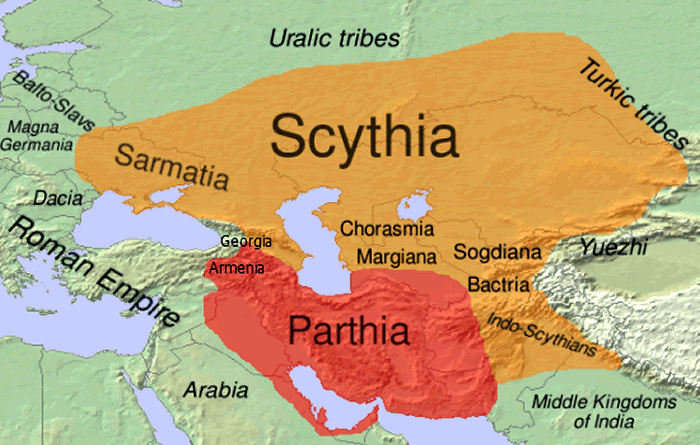

Parthian Empire
The Parthian Empire was the empire founded in Iran by Arsaces I, the Parni leader, who invaded Parthia in 238 BC. After the death of Alexander the Great in 323 BC, Parthia was a province governed by the Seleucid rulers of Persia. By 246 BC, Ptolemy III waged war against the Seleucid Empire and invaded Babylon and Antioch. In 241 BC, Ptolemy III won parts of Syria in his peace negotiation with the Seleucid administration. By this time, the Parni invaded Parthia (247 BC) and established the Arsacid dynasty, named after Arsaces. I
The Arsacid Dynasty
Andragoras was the Seleucid governor of Parthia in around 250 BC. He proclaimed Parthia’s independence from the Seleucid rule. Arsaces I took advantage of Parthia’s lack of Seleucid backing and invaded Astauene and effectively all of the Parthian Empire. Arsaces I successfully fought off Seleucid II. He successfully maintained the independence and cohesion of his kingdom in the face of Ptolemy’s invasion of the Seleucid Empire. Historical records about the reign of Arsaces I are unclear. It is, however, believed that he ruled until about 211 BC. He was succeeded by his brother Tiridates in 211 BC.
Andragoras was the Seleucid governor of Parthia in around 250 BC. He proclaimed Parthia’s independence from the Seleucid rule. Arsaces I took advantage of Parthia’s lack of Seleucid backing and invaded Astauene and effectively all of the Parthian Empire. Arsaces I successfully fought off Seleucid II. He successfully maintained the independence and cohesion of his kingdom in the face of Ptolemy’s invasion of the Seleucid Empire. Historical records about the reign of Arsaces I are unclear. It is, however, believed that he ruled until about 211 BC. He was succeeded by his brother Tiridates in 211 BC.
rsaces I was succeeded by Artabanus I who styled himself Arsaces II, others maintain that Arsaces I was succeeded by Tiridates I and then by the latter’s son, Artabanus I. The dates of the reign of these kings are not known with any certainty. It is likely that Artabanus I was the nephew of Arsaces I and took on the name Arsaces II, and that his reign lasted until 191 BC. In around 209 BC, Antiochus III, the Seleucid sovereign reclaimed the Parthian Empire. Arsaces II settled for a vassal status but when Antiochus III busied himself with the Roman onslaught, he ruled Parthia without much interference. The Arsacid king who succeeded Arsaces II was Phriapatius who ruled Parthia until 176 BC.
Mithridates the Great
Phriapatius was succeeded by his son, Phraates I. Phraates I ruled for about five years from 176 BC to171 BC. He named Mithridates I, his brother, as his successor. Mithridates I, also known as Mithridates the Great was the greatest among the Arsacid rulers. A very ambitious ruler, Mithridates expanded the eastern, western, and southern boundaries of the Parthian Empire to include Babylonia, Media, Herat, and most of Persia. Mithridates in his reign made Parthia a major empire, far from the vassal state that it had been.
Mithridates’ earliest victory was won against King Eucratides. He annexed Bactria and gained control of the Bactrian stronghold, Herat in 167 BC. In 139 BC, Mithridates defeated King Demetrius II, the Seleucid ruler of Persia. He thus annexed Babylon and most of Persia. Demetrius II was held prisoner by Mithridates. But in a gesture characteristic of the rulers of Persia, Mithridates released him and gave him his daughter in marriage.
Mithridates took control of the famous trade route referred to as the Silk Route. This brought the Parthian Empire much wealth and prosperity. He also was instrumental in spreading the Hellenic culture in his empire. Mithridates the Great was succeeded by his son Phraates II.
Phriapatius was succeeded by his son, Phraates I. Phraates I ruled for about five years from 176 BC to171 BC. He named Mithridates I, his brother, as his successor. Mithridates I, also known as Mithridates the Great was the greatest among the Arsacid rulers. A very ambitious ruler, Mithridates expanded the eastern, western, and southern boundaries of the Parthian Empire to include Babylonia, Media, Herat, and most of Persia. Mithridates in his reign made Parthia a major empire, far from the vassal state that it had been.
Mithridates’ earliest victory was won against King Eucratides. He annexed Bactria and gained control of the Bactrian stronghold, Herat in 167 BC. In 139 BC, Mithridates defeated King Demetrius II, the Seleucid ruler of Persia. He thus annexed Babylon and most of Persia. Demetrius II was held prisoner by Mithridates. But in a gesture characteristic of the rulers of Persia, Mithridates released him and gave him his daughter in marriage.
Mithridates took control of the famous trade route referred to as the Silk Route. This brought the Parthian Empire much wealth and prosperity. He also was instrumental in spreading the Hellenic culture in his empire. Mithridates the Great was succeeded by his son Phraates II.
Downfall of the Empire
Phraates II took over the empire of Mithridates in 138 BC. He ruled the Parthian Empire for ten years until 128 BC. He successfully beat back the army of Antiochus VII the Seleucid king but died fighting the Scythians in Media. The reign of Artabanus I was a short one that ended in 124 BC, when he died fighting the Scythian invaders. A quick succession of kings - Gotarzes I, Orodes I, Sanatruces, Phraates III, Orodes II, and Phraates IV - ruled the Parthian Empire through the first century BC. Mounting rivalry with Rome and the invasion of many nomadic tribes had greatly weakened the once mighty Parthian Empire. The Parthian kings of the first century AD took on many Roman characteristics. Parthia was ravaged by civil wars and continued hostilities with the Roman rulers. In 224 AD, the Sassanids of Persia invaded Parthia and annexed it.
Phraates II took over the empire of Mithridates in 138 BC. He ruled the Parthian Empire for ten years until 128 BC. He successfully beat back the army of Antiochus VII the Seleucid king but died fighting the Scythians in Media. The reign of Artabanus I was a short one that ended in 124 BC, when he died fighting the Scythian invaders. A quick succession of kings - Gotarzes I, Orodes I, Sanatruces, Phraates III, Orodes II, and Phraates IV - ruled the Parthian Empire through the first century BC. Mounting rivalry with Rome and the invasion of many nomadic tribes had greatly weakened the once mighty Parthian Empire. The Parthian kings of the first century AD took on many Roman characteristics. Parthia was ravaged by civil wars and continued hostilities with the Roman rulers. In 224 AD, the Sassanids of Persia invaded Parthia and annexed it.
Subscribe to:
Posts (Atom)